
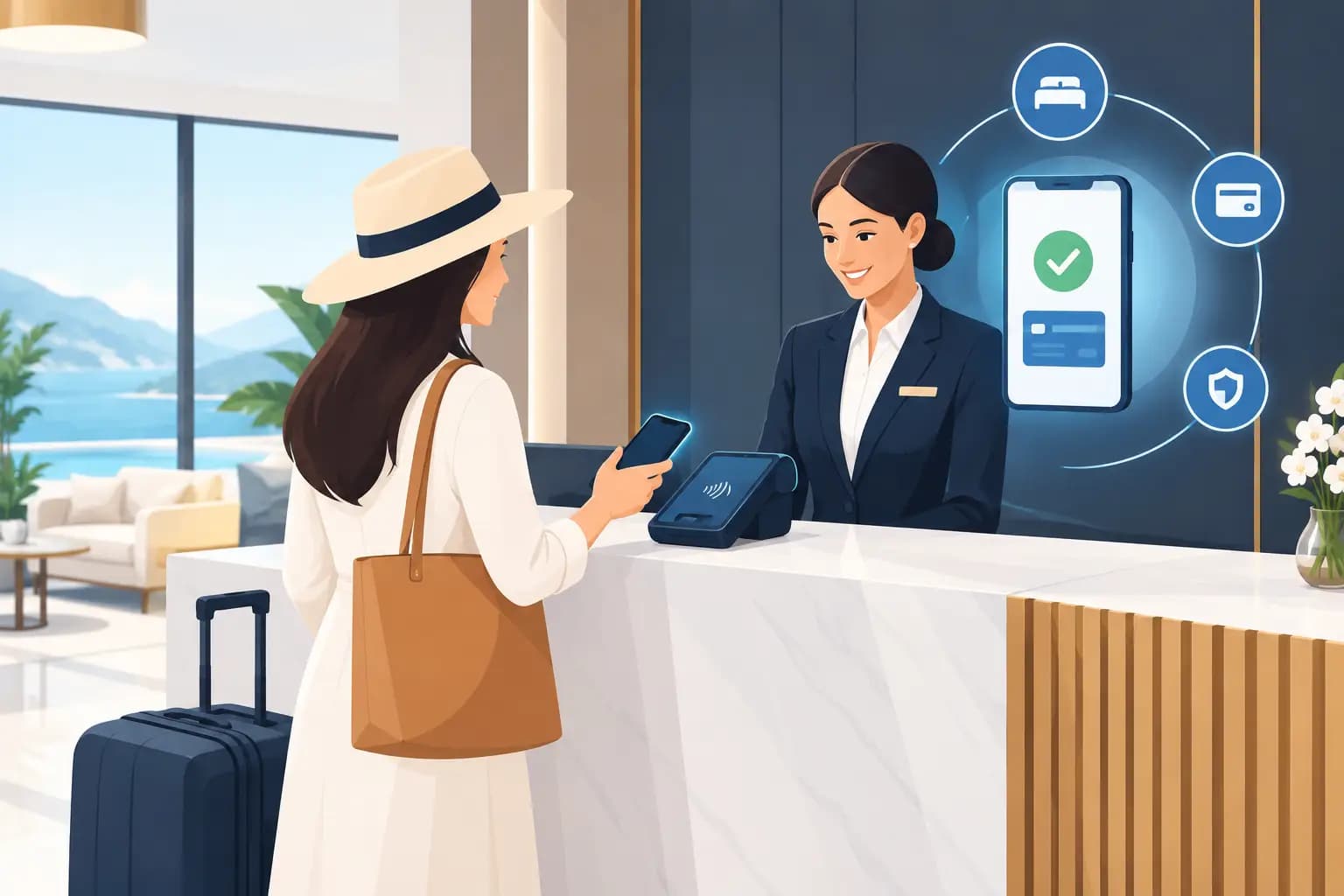
A guest’s departure shouldn’t end with a declined card, an invoice waiting to be checked or a manual charge that nobody remembers making. Automated hotel payments turn one of the most sensitive points of the operation into a controlled process: collecting at the right moment, recording every transaction and giving the front desk more time to look after the guest.
For an independent hotel, a holiday apartment business or a chain, automating payments isn’t just about accepting cards online. It means linking bookings, cancellation policies, payments, invoicing and reconciliation within a single operational logic. The result is less admin work, less exposure to errors and more predictable cash flow.
What are automated hotel payments?
Automated payments are processes set up to execute, validate and record charges according to rules defined in advance. These rules can be triggered when a booking is confirmed, a few days before arrival, during check-in, when an extra is purchased or at the end of the stay.
Instead of the team copying details from a booking, looking for a card, entering an amount and manually updating the PMS, the system handles the flow in an integrated way. The booking says what has to be charged, when and under what conditions. The payment is linked to the guest’s record and the front desk can check its status without piecing the information together from different programs.
Automation works particularly well when the property receives bookings from several channels: its own website, OTAs, agencies, phone or email. Each source may have different conditions, but the hotel needs a single view of the payment. Without that centralisation, complexity grows with every booking, and so does the risk of a charge slipping through.
Why automating payment collection improves profitability
The most visible benefit is time saved, but it isn’t the only one, nor always the most relevant. A well-automated payment process protects revenue that might otherwise be lost to late cancellations, no-shows, unclaimed deposits or follow-up errors.
When the payment policy is applied consistently, the hotel depends less on one person remembering every step. For example, a non-refundable rate can be charged at the moment the booking is confirmed; a flexible booking can require a guarantee and charge the first night before arrival; a long stay can be split into several scheduled payments. It isn’t about charging early by default, but about applying the commercial policy designed for each product.
It also improves the guest experience. Nobody wants to repeat their payment details several times, wait at check-out while charges are reviewed or receive unexpected amounts. A clear flow, with advance communication and an accurate record, conveys professionalism from booking to departure.
For management and revenue management, the advantage is different: reliable information on payments made, pending, failed and expected. This visibility makes cash decisions easier, avoids chasing payments at the last minute and helps you spot patterns, such as a channel with too many invalid cards or a rate with unclear conditions.
The critical moments worth automating
Not every property needs the same flow. A city hotel with high turnover will have different priorities from a campsite, a resort with restaurants or holiday apartments with long stays. Even so, there are several points in the booking cycle where automation adds direct value.
Booking confirmation and guarantee
The first step is to validate that the booking has a valid guarantee. Depending on the rate and the channel, this can mean a pre-authorisation, a deposit charge or full prepayment. The key is that the rule triggers on its own and that the status is reflected on the booking.
This avoids a common situation: bookings confirmed with faulty cards that are only discovered on the day of arrival, when it’s already hard to recover the revenue or resell the room.
Payments before arrival
Scheduling payments before check-in helps reduce no-shows and speeds up the guest’s arrival. It is especially useful on high-demand dates, for group bookings, non-refundable rates and high-value stays.
However, the rule must be aligned with the conditions communicated to the customer. Automating a charge without a transparent policy leads to incidents, refunds and reputational damage. Technology carries out the operation, but the commercial judgement remains the property’s responsibility.
Extras, charges and payments during the stay
A property doesn’t only sell nights. Breakfasts, parking, treatments, activities, restaurant meals, late check-out or pet services can increase revenue per guest. If these charges are recorded separately, the front desk has to consolidate them by hand before invoicing.
By integrating charges with the guest’s account, the team can see the up-to-date balance and apply the authorised payment method when appropriate. In properties with several points of sale, this integration prevents discrepancies and shortens the daily close.
Check-out and final invoicing
Check-out is the moment when any error becomes most visible. A payment that is automated and correctly linked to the booking lets you review exceptions, not routine transactions. If the amounts are already reconciled, the front desk can focus on handling guest requests, issuing the correct invoice and closing the stay smoothly.
How to implement automated hotel payments without creating more friction
Automation shouldn’t add a layer of complexity. If staff need to open several tools to check a card, record a payment and issue an invoice, the process is still manual even if it has digital buttons.
The starting point is to define the property’s payment policy. You need to decide which rates require a deposit, how much is charged at each stage, how cancellations are handled, when penalties apply and what happens if a charge fails. These decisions should reflect your distribution strategy and customer profile, not a generic configuration.
Next, review your booking channels. Direct bookings give you more control over the payment flow and communication with the guest. OTAs, on the other hand, may operate with virtual cards, their own collection or specific conditions. The PMS must tell these cases apart to avoid duplicate charges or wrong actions.
Integration is decisive. A payment system connected to the PMS, booking engine, channel manager and invoicing keeps information up to date in a single environment. Avirato, for example, takes this integrated view so that payment isn’t a process separate from the booking, the operation and direct sales.
Before switching the flow on for the whole property, it’s advisable to test real scenarios: a change of dates, a cancellation within the deadline, a declined card, an OTA booking, a no-show and a partial refund. It’s the exceptions that determine whether the process is truly ready for day-to-day use.
Mistakes that reduce the value of automation
The first mistake is automating without communicating. Guests must know what amount will be charged, on what date and under what conditions. Confirmation and pre-stay messages are part of the payment process, not an administrative detail.
The second is using the same rules for every booking. A promotional rate, a group sale, an intermediated channel and a direct booking shouldn’t always be treated the same way. Effective automation segments rules without forcing the team to step in booking by booking.
The third is ignoring failed payments. A system doesn’t eliminate these incidents, but it can detect them quickly and trigger alerts or follow-up tasks. The sooner the customer is contacted or a new guarantee is requested, the more options the hotel has to protect the booking.
Finally, don’t measure success only by the number of transactions processed. You should also look at the front-desk time spent on payments, the percentage of invalid cards, no-shows recovered, invoicing errors and reconciliation time. These indicators show whether the technology is genuinely improving the operation.
Automated payments work best when they respect the property’s strategy and free the team from repetitive tasks. The aim isn’t to dehumanise the stay: it’s to keep every payment under control so that the front desk can devote its attention to what does require a personal touch.