
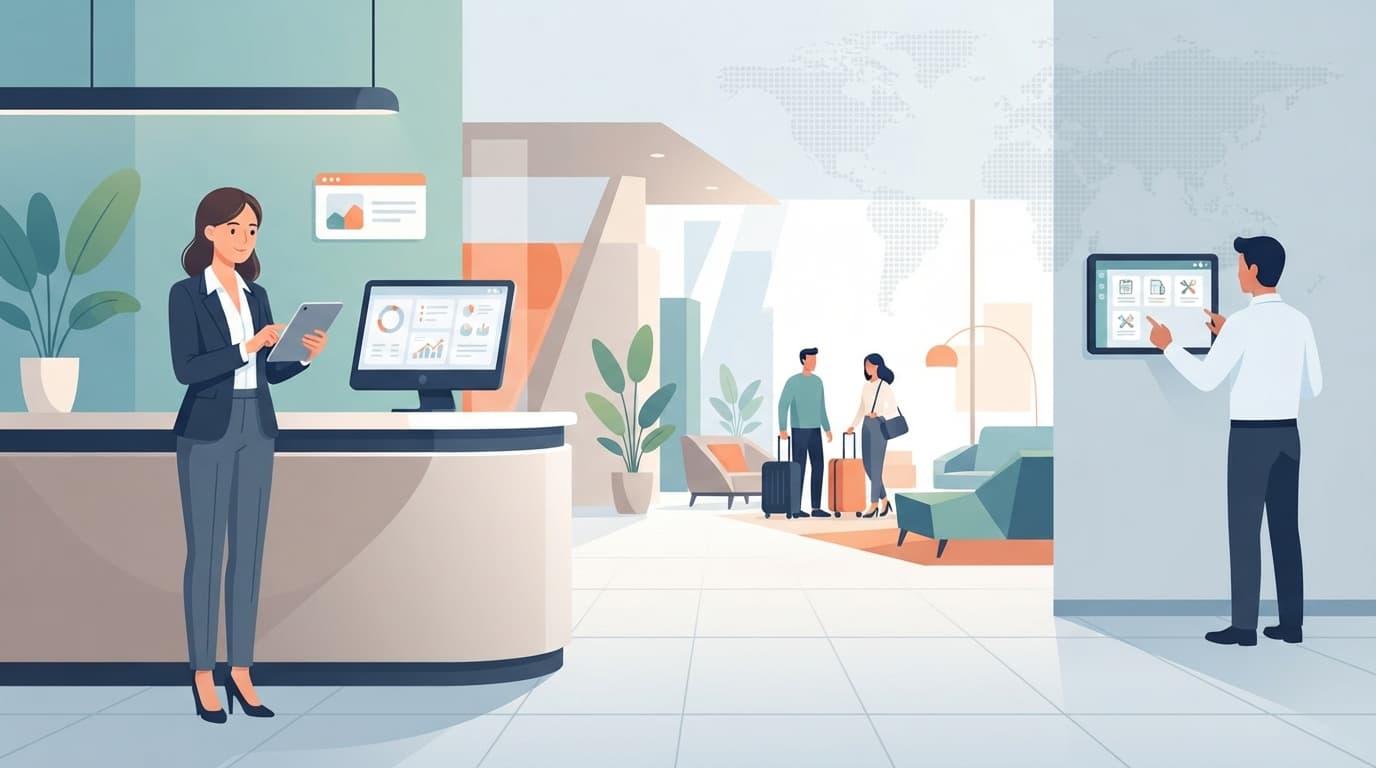
Automating daily operations across hotel chains means bringing bookings, payments, check-in and guest communication together on a single platform, doing away with manual tasks and cutting errors. With an all-in-one PMS and a channel manager with instant sync, each property keeps its autonomy while the chain gains real-time visibility.
Managing hotel chains is still, in many cases, a patchwork of disconnected tools: spreadsheets for rates, emails to coordinate availability and front desks re-entering the same data into several systems. The result is availability errors, misapplied charges and a partial view of the business. Automating daily operations isn't about jumping on the latest tech bandwagon: it's about handing control back to your teams and freeing up time to look after guests.
When I talk to directors of mid-sized chains, the pattern repeats itself. They have two, five or fifteen properties. They've grown fast. And the way of working that served a single hotel has become a burden. The good news is that there's now technology built specifically for this scenario, letting you centralise what matters without stifling each property's autonomy.
What does automating daily operations across hotel chains involve?
Automating daily operations across hotel chains doesn't mean a robot does everything. It means the repetitive, error-prone tasks — syncing rates, pulling bookings from OTAs, reconciling payments, sending confirmations — run themselves, consistently across the whole chain. That calls for a platform acting as the backbone: a multi-property PMS that shares master data but allows local rules per property.
A clear example: if you decide to change your cancellation policy or launch a non-refundable rate, you shouldn't have to update each portal by hand. With an integrated channel manager, the rule applies across all channels at once and is reflected in your own booking engine. That's automation with a real impact on revenue and on operational peace of mind.
Key areas for reducing errors in hotel chain management
I've identified four areas where automation makes an immediate difference:
1. Availability and rate sync
Overbookings and underselling usually stem from manual updates. A channel manager with instant sync prevents you from selling too many or too few rooms, and frees up the revenue manager to focus on strategy rather than firefighting.
2. Online check-in and automated front desk
The arrival process eats up valuable time at every property. Automating data capture, sending instructions and verifying documents cuts queues, registration errors and admin workload. For high-turnover chains, it's a game-changer.
3. Integrated payments and automatic reconciliation
Integrated payments let you charge, refund and reconcile payments from within the system itself. No more manual cross-checking between card terminals, payment gateways and bank statements. Fewer manual steps, fewer discrepancies and tighter cash flow control per property and across the group.
4. Centralised communication and loyalty
Unified email marketing and guest management keep your relationship with the customer consistent, whichever hotel in the chain they stay at. Stay and preference data travels with the guest, and that shows up in repeat bookings and direct sales.
Table: where to start automating based on your chain's stage
| Chain situation | Automation priority | Main benefit |
|---|---|---|
| Recent growth (2-5 properties) | Multi-property PMS and channel manager | Avoid availability discrepancies |
| Operations with lots of manual check-ins | Online check-in and automated front desk | Reduce errors and waiting times |
| Payments scattered across properties | Integrated payments (Avirato Payments) | Automatic reconciliation and cash flow control |
| Guests lost to OTAs through lack of relationship | Email marketing and centralised loyalty | Increase direct sales and repeat bookings |
Common mistakes when digitising a hotel chain
Automating without seeing the bigger picture is the most costly mistake. Buying a PMS for each hotel, keeping channels out of sync or failing to integrate the booking engine with the channel manager are all missteps that end up creating more manual work, not less. The key is to choose a solution that lets you grow in phases, without switching tools halfway through.
Another common mistake is forgetting your teams. The best platform fails if front desk staff don't use it. That's why implementation must go hand in hand with training and clear processes per property. Automating isn't about removing people, it's about removing tasks that add no value.
How to start automating daily operations across hotel chains with Avirato
Avirato is built to make that leap smoothly. Its all-in-one PMS, channel manager with instant sync, online check-in, integrated payments and unified guest management let each property operate independently while the chain keeps a single, coherent view. AI applied to operations (Avirato Intelligence) helps spot patterns and automate routine decisions, without the director losing control.
For chains that want to grow without multiplying complexity, this approach changes the rules. It's not about adding more tools, but consolidating into a single digital backbone. If you'd like to see it in action, I'd invite you to explore a free Avirato demo or start a trial. No commitment, and with one clear goal: to turn your operations from a brake into a competitive advantage.
Frequently asked questions
What exactly does automating daily operations in a hotel chain mean?
It means eliminating repetitive manual tasks (rate syncing, pulling bookings, guest registration, payment reconciliation) through an all-in-one PMS and a connected channel manager. That way, information flows automatically between properties and channels, cutting errors and freeing up your team's time.
Can a PMS for hotel chains respect each hotel's autonomy?
Yes. A good multi-property PMS lets you centralise master data and shared policies, but also configure property-specific rules, rates and processes. That way, each director keeps local control while the chain gains a global view.
How long does it take to implement this kind of solution in a chain?
It depends on the number of properties and your starting point. With a cloud platform like Avirato, rollout is usually quick thanks to centralised configuration and instant channel sync. The most important part is training your teams and defining shared processes.
Does automation eliminate front desk jobs?
No. Automating admin tasks doesn't mean doing away with people. On the contrary, it frees front desk staff to focus on guest service, resolving issues and upselling services, which is where they add the most value.
What are the advantages of integrating payments into the same platform for a hotel chain?
Integrated payments let you charge, refund and reconcile automatically from within the system, with no external gateways or manual cross-checking. For a chain, that means fewer reconciliation errors, tighter cash flow control per property and a consolidated financial view.