
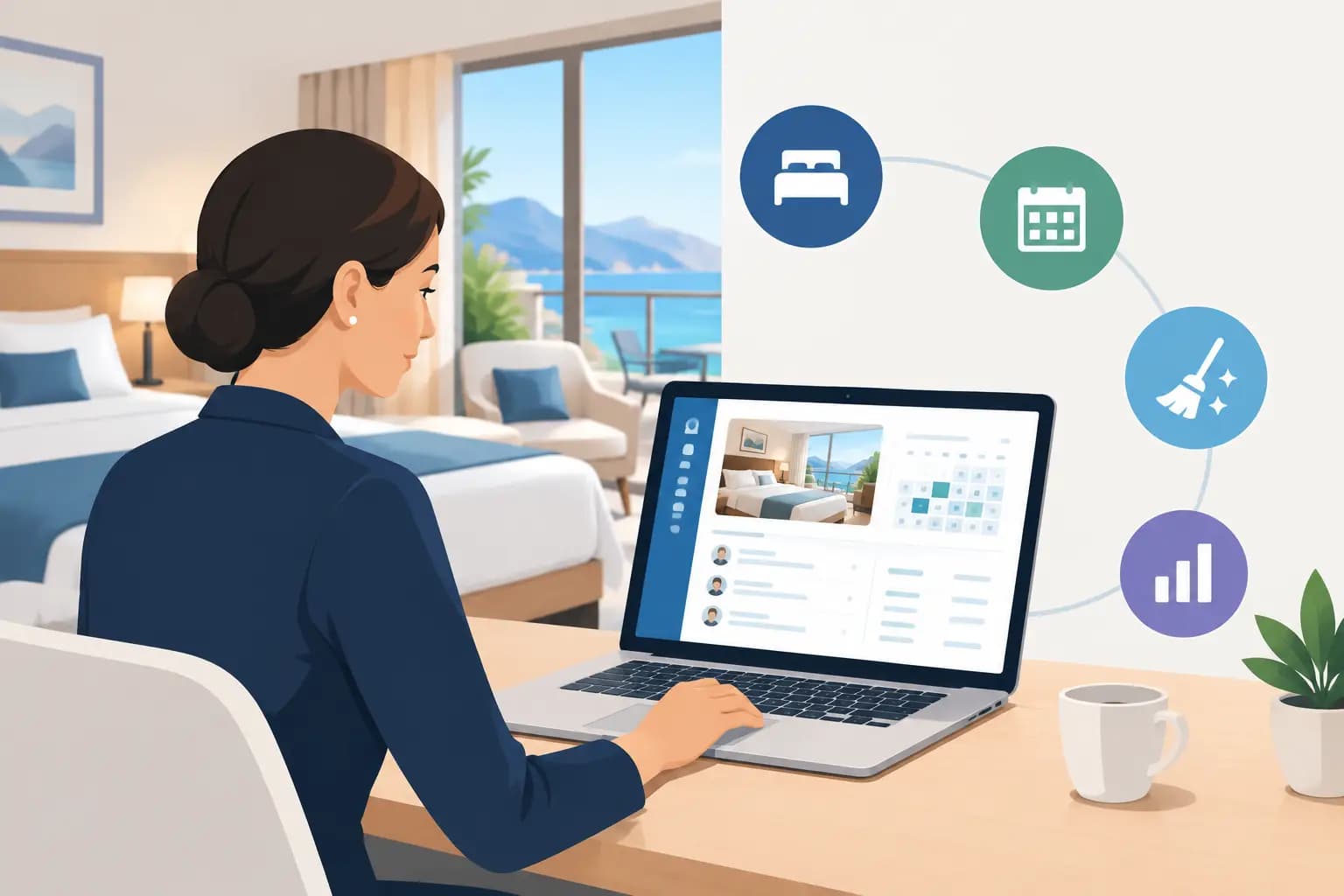
A front desk with bookings noted down on several screens, rates that are updated late and payments still pending is not just an organisational problem. It is a direct leak of time, margin and sales opportunities. Searching for software for independent hotels is, in essence, a search for exactly that: taking back control of the business without piling on more disconnected tools.
For an independent hotel, competing does not mean having the same budget as a large chain. It means operating intelligently, reacting quickly to demand and giving guests a smooth experience from booking to check-out. The right technology should help you achieve that from a single environment, not add complexity to the working day.
What software for independent hotels needs to solve
The starting point is not a list of features but the real friction points in your property. If reception has to copy bookings manually from every OTA, if rates do not sync instantly or if the team does not know which bookings have been paid, the problem will not be solved by adding yet another isolated application.
Well-designed hotel software connects operations, distribution, direct sales and revenue management. The PMS holds the information on bookings and stays. The Channel Manager updates availability and prices across your sales channels. The booking engine lets you capture direct sales on your website, with no intermediary commissions. Payments, online check-in and guest communications complete a journey that is more efficient for the team and more comfortable for the guest.
The difference lies in all of these processes sharing data in real time. When a room is sold on one channel, availability must be adjusted immediately on the rest. When the guest pays online, reception must see the payment status without chasing confirmations. When demand changes, the commercial manager must be able to review rates and restrictions with a clear view of occupancy.
Why a unified system improves profitability
Technological fragmentation seems manageable at first. One supplier for the PMS, another for the OTAs, another for payments and an extra tool for email marketing can all look like reasonable choices. However, every connection adds tasks, potential errors, costs and dependence on different support teams.
A unified ecosystem reduces duplicated work. The team stops entering the same information several times, inventory errors fall and it becomes easier to get reliable data for decision-making. This is especially relevant in small and mid-sized hotels, where each person often covers several roles during the day.
It also improves your ability to sell. An integrated booking engine should do more than display availability. It should make mobile bookings easy, apply promotions, offer extras and reflect up-to-date prices. Direct sales gain weight when the process is simple and competitive, not just when more is spent on campaigns.
Profitability, therefore, does not depend solely on filling rooms. It depends on selling the right inventory, at the right price, on the channel that leaves the best margin and with the least administrative burden. That is why the software has to serve reception as much as management and revenue management.
Features to prioritise before you sign up
Not every property has the same needs. An urban hotel with high turnover requires a fast front desk and corporate account management. A holiday property needs to handle long stays, advance bookings and packages. A campsite or resort with catering may need additional operations for different points of sale. Even so, there are capabilities worth assessing in every case.
A PMS built for real-world operations
The PMS should let you manage individual and group bookings, check-in and check-out, rooms, customers, invoicing, payments, deposits and incidents from a single record. Usability matters: a very complete function that takes too many steps ends up meeting resistance from the team.
It is also worth checking that the information can be accessed from any authorised device and that the system keeps a useful guest history. Knowing preferences, previous stays or special requests helps you personalise the service without relying on scattered notes.
A Channel Manager with instant synchronisation
Overbooking does not always happen because you sell too much. Often it appears because the allotment update is slow, a restriction has not been applied properly or the team changes rates by hand on several channels. A Channel Manager connected to the PMS should centralise prices, availability and sales conditions to minimise that risk.
Before choosing, review which OTAs, metasearch engines and distributors you need to connect. It is not about being on every channel, but about managing precisely those that bring profitable demand to your property. The quality of the synchronisation and technical stability are worth more than a long list of integrations you never use.
Integrated booking engine and payments
A hotel’s website should work as a sales channel, not as a simple shop window. The booking engine has to be fast, clear and consistent with your brand, as well as supporting promotional codes, the sale of extra services and flexible conditions whenever the business requires them.
Integrating payments reduces manual follow-up, speeds up confirmations and improves cash control. Automating advance payments, guarantees and payment links can reduce last-minute cancellations and free up reception time. That said, you should set transparent policies and review how refunds, changes and partial payments are handled.
Revenue management that is useful, not opaque
Price recommendations add value when they are understood and can be applied with judgement. A revenue management system should combine occupancy, booking pace, future demand, competitors and rules defined by the hotel. Automation does not replace your knowledge of the property: it turns it into faster, more consistent decisions.
For some hotels, price suggestions will be enough. For others, it will be key to automate changes within defined limits, by season, channel, room type or occupancy level. The important thing is to stay in control and be able to measure the effect of each decision on revenue and margin.
How to choose software for independent hotels without getting it wrong
The best decision starts with documenting your processes, not with requesting a generic demo. Identify where the team loses time, which mistakes keep recurring and which indicator you want to improve. It might be reducing overbooking, increasing direct bookings, shortening check-in, controlling payments or raising revenue per available room.
Then ask for a demo based on real situations at your property. Ask to see how a booking is created, how a rate is changed across several channels, how a payment is recorded, how a day-end close is done and how reports are extracted. If an everyday task is not clear during the demo, it will hardly be simpler after implementation.
Training and support deserve the same attention as features. Changing systems affects reception, management, reservations and sales. Data migration, initial set-up and the availability of help at critical moments determine adoption. A supplier should act as a business ally, offering practical guidance and hospitality know-how.
It is also advisable to assess the total cost, not just the monthly fee. Consider commissions, integrations, training, minimum-term conditions, the modules you need and the time the team spends on manual tasks today. A more complete system may require a larger initial investment, but prove more profitable if it eliminates duplicated tools and improves direct sales.
Technology to grow without losing the personal touch
Digitalising an independent hotel does not mean dehumanising it. On the contrary: when the system takes care of repetitive tasks, the team can devote more attention to handling a special request, recommending a local service or dealing with an issue quickly. Guests notice the difference.
Avirato brings together PMS, Channel Manager, booking engine, payments, revenue tools, online check-in and loyalty in a single platform designed to centralise management and grow bookings. For the property, the advantage is working with one view of operations and commercial performance, instead of rebuilding the information from separate tools.
The right choice will depend on the size, the type of accommodation and the goals of each business. But there is one question that helps you decide: does this technology simplify daily work and leave the hotel better placed to sell more? If the answer is clear, the investment stops being an operating cost and becomes a growth decision.