
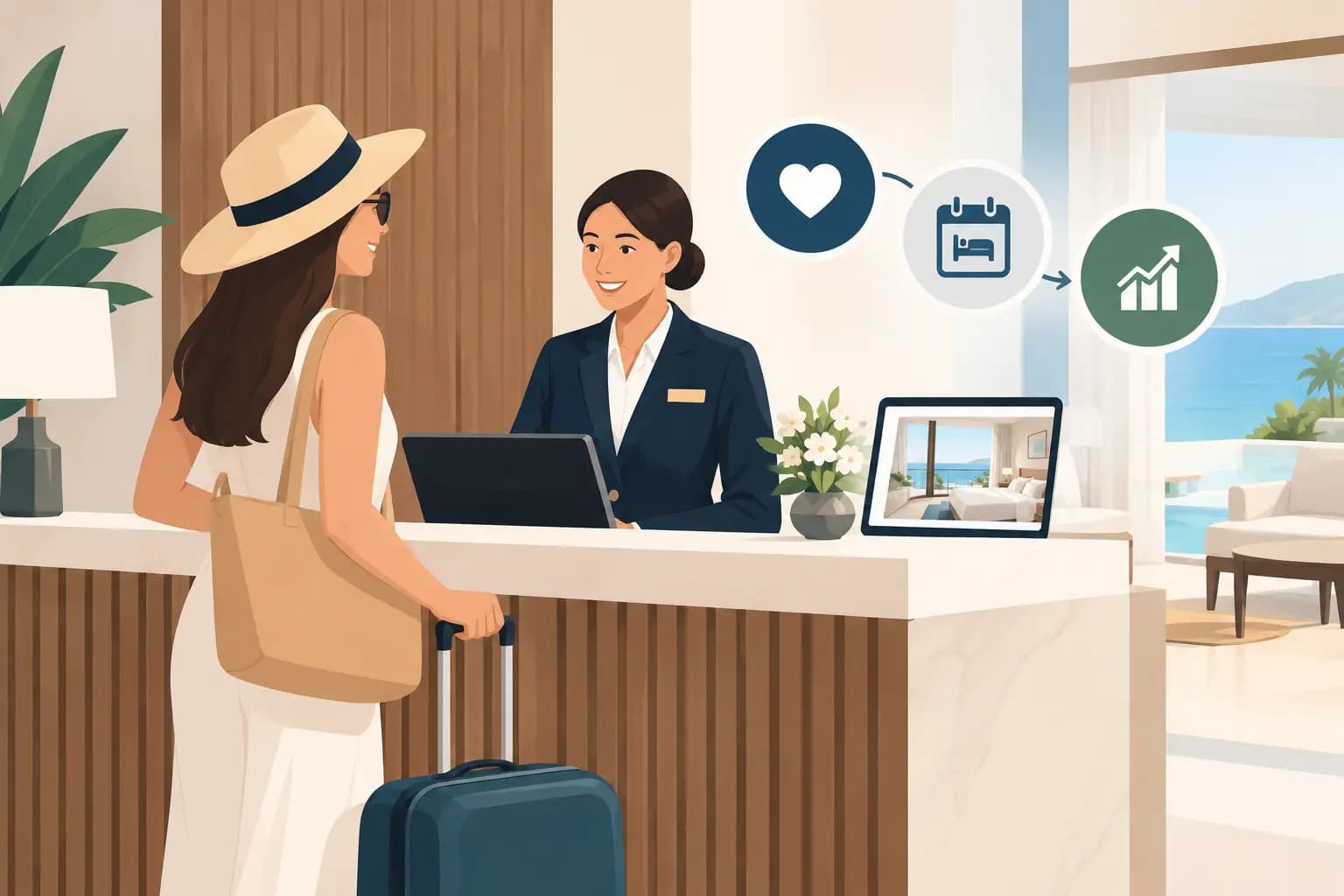
A guest who leaves satisfied does not always come back. They may have enjoyed the room, appreciated the team and left a good review, but they will book through an OTA again if the hotel does not keep the relationship active. Hotel guest loyalty turns that one-off satisfaction into a repeated commercial decision: to return, to book through the direct channel and to recommend the property.
For an independent hotel, a holiday apartment business or a chain, retaining guests is not about handing out discounts indiscriminately. It is about recognising the guest, making every step easy and giving them relevant reasons to choose your property again. Done well, this strategy reduces dependence on intermediaries, protects your margin and improves demand forecasting.
Why hotel guest loyalty affects revenue
Winning new demand has a cost: advertising spend, distribution commissions, sales time and pressure on rates. A guest who already knows the property needs less convincing, as long as the experience and the follow-up offer live up to expectations.
What’s more, a returning guest tends to book with greater confidence. They may choose a higher category, add breakfast, buy an extra service or book further in advance. It is not an automatic rule: it depends on the type of property, the reason for travel and how often that guest visits the destination. But having a well-managed database of your own gives the hotel a commercial capability that it does not get if the relationship ends at check-out.
The priority should not be to grow the number of members in a programme, but to raise specific indicators: repeat rate, direct booking share, average booking value, ancillary revenue and acquisition cost. If an action generates bookings with a discount that destroys margin, it is not building loyalty profitably.
The starting point: useful data and connected operations
Loyalty fails when reception, reservations, payments, marketing and distribution work with incomplete or disconnected information. If a guest has stated preferences, had an issue or stayed several times, the team should be able to see it without digging through spreadsheets or checking several tools.
A centralised PMS makes it possible to build a more useful guest profile: stay history, booking channel, spend, preferences, accepted communications and relevant requests. The aim is not to hoard data for its own sake. It is to give the team context so they can look after guests better and segment with sound judgement.
It is also worth checking data quality at source. An online check-in can help collect information before arrival and cut administrative tasks at reception. Digital payments, bookings from your own engine and integrations with other services complete a more reliable picture of guest behaviour.
That said, personalisation has limits. Ask only for the information you need, manage communication consents and comply with the applicable regulations. A well-timed message can reinforce trust; an intrusive campaign has the opposite effect.
Segment to add value, not to send more emails
Not every guest should receive the same offer. A business traveller who stays midweek responds to different incentives from a family booking in summer or a couple looking for a weekend break. Splitting by type of trip, frequency, spend, origin, booking lead time and services used lets you create campaigns with a clear commercial reason.
For example, a property with low occupancy on certain dates can target past guests who travel off-season. If the profile looks for short stays, a two-night offer with late check-out can be more attractive than a generic discount. If it is a frequent business guest, a quick booking process, simplified invoicing and flexible terms may be worth more.
Segmentation should be simple at the start. Three or four well-defined, measurable groups usually perform better than a complex structure that nobody maintains.
Design an experience worth repeating
Technology organises processes, but it does not replace the moments guests remember. Loyalty is built before arrival, during the stay and after departure.
Before arrival, clear communication reduces uncertainty: times, how to get in, parking options, available services or genuinely useful recommendations. During the stay, the difference can lie in honouring a noted preference, resolving an issue quickly or sparing the guest from repeating information they have already given.
After check-out begins a phase that many properties waste. Thanking guests for their visit, asking for a review and opening the door to a future direct booking should be part of a planned flow. There is no need to send an immediate promotion to everyone. In some cases an invitation to return in the right season will work; in others, an offer tied to a special date or a local event.
Consistency matters more than spectacular gestures. Promising benefits that reception cannot apply, offering codes that fail or advertising a perk with no availability will damage the relationship more than having no loyalty programme at all.
Benefits that protect your margin
A discount is easy to communicate, but it should rarely be the only incentive. When every guest gets a lower price, the hotel trains the market to wait for sales and can end up competing against itself. It is better to combine controlled-cost perks with benefits that improve the experience.
These could be priority for requests, early check-in or late check-out subject to availability, a welcome drink, flexible terms for returning guests, preferential access to room upgrades or packages that add value. The key is to calculate their real operating cost and set clear rules for applying them.
In holiday accommodation, where repeat visits can be annual, it is also worth nurturing destination memory. A message sent months before the usual travel date, together with a relevant direct offer, can win back demand without entering a price war.
Direct booking should be the most convenient option
It is not enough to ask guests to book directly next time. The booking engine must offer a quick, mobile-friendly process that is consistent with the offer you have communicated. Rates, availability, promo codes and terms must be in sync to avoid friction.
There is a balance to strike here. Offering exclusive perks on the direct channel is legitimate and profitable, but you must respect existing distribution agreements and keep your pricing strategy under control. The promise to the guest should be clear: booking directly gives them a closer relationship with the property and concrete benefits, not a confusing experience.
An integrated platform such as Avirato helps connect the PMS, booking engine, payments, marketing and loyalty tools so that information is not spread across suppliers. The aim is not to add technology, but to remove manual steps and act on up-to-date data.
Automate without losing your team’s judgement
Automations are especially useful for repetitive tasks: confirmations, pre-arrival reminders, post-stay thank-yous, satisfaction surveys or campaigns for guests who have not returned within a given period. They save time and make sure contact does not depend on someone remembering to do it.
But automating does not mean always sending the same message. Review your flows, exclude anyone with an open issue and set reasonable pauses. A guest who has just cancelled for personal reasons does not need to receive a pushy come-back campaign the next day.
Reception also plays a decisive role. It must know which guests are returning, which benefit has been assigned to them and when it makes sense to step in personally. Automation prepares the ground; the team turns information into hospitality.
Measure loyalty with concrete decisions
Hotel guest loyalty needs monthly follow-up, not just a one-off campaign. Compare repeat business by channel, segment and season. Look at how many guests book directly again, how much time passes between stays and what revenue they generate compared with first-time guests.
Also analyse qualitative signals: reasons for cancellation, recurring comments in surveys and reviews, frequent requests and friction points in the booking process. If many guests value the service but do not return, the problem may not be the experience, but the lack of relevant follow-up communication or an uncompetitive direct engine.
Do not chase every indicator at once. Choose one priority objective for each period, such as raising the direct share among repeat guests or reactivating low-season customers, and test a specific offer. Measure the result, adjust and keep what adds margin.
Guests do not return because they belong to a database. They return when they remember that their time was well looked after, that booking was easy and that the hotel understands what they need. That is the relationship worth building, stay by stay.