
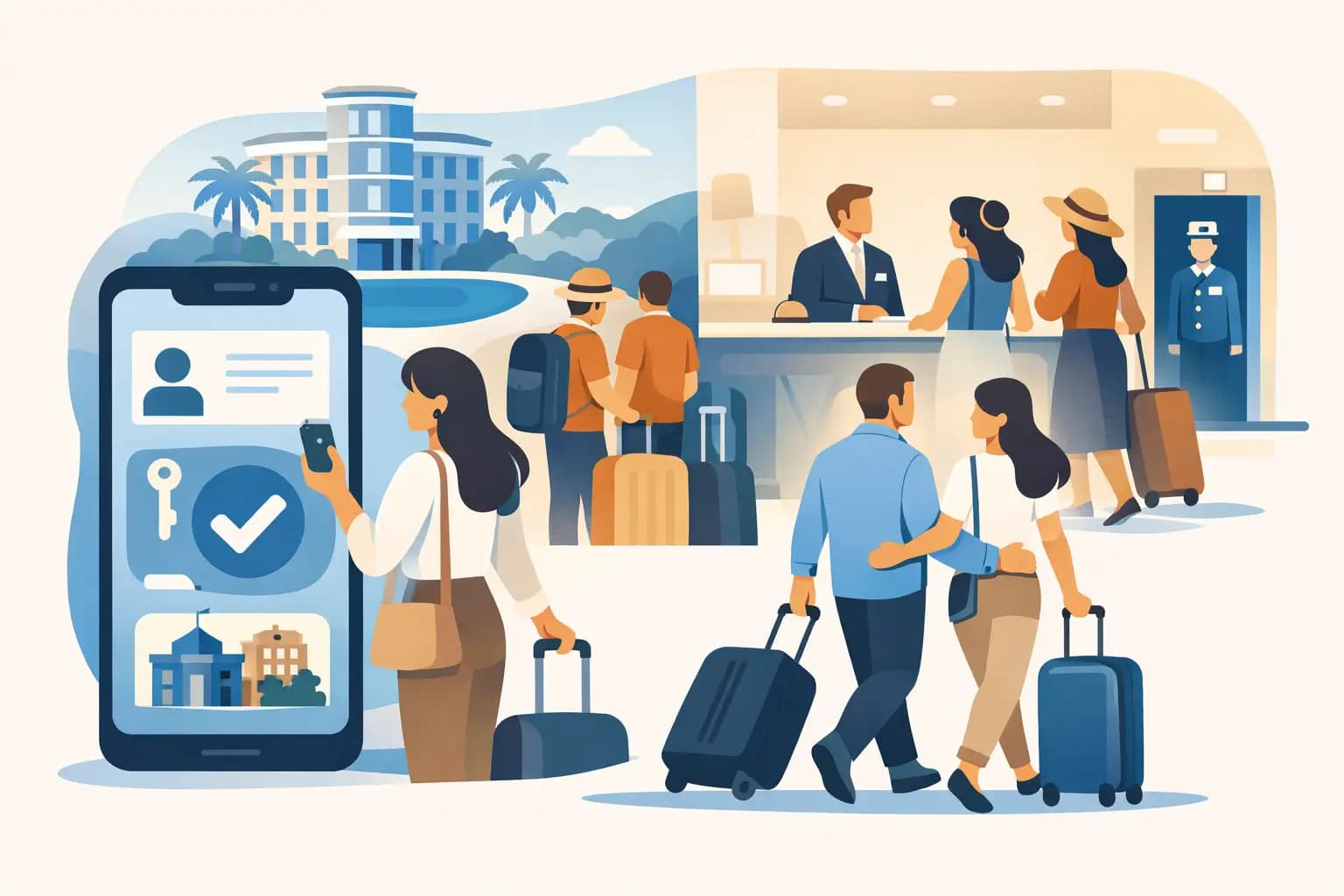
Arrivals bunched between 2 pm and 4 pm can put even a well-staffed front desk to the test. When guests have to wait to identify themselves, sign, pay or get basic information, hotel check-in stops being a welcome and becomes an operational bottleneck. The difference is not only about serving people faster: it is about preparing every arrival before the guest walks through the door.
For a property, improving this process has a direct impact on the guest experience, online reputation and team productivity. It also opens up a commercial opportunity: a front desk that is less tied up with repetitive tasks can spend more time resolving issues, recommending services and helping those who genuinely need assistance.
Hotel check-in starts before arrival
The usual mistake is to see check-in as a task for the front desk alone. In reality, the process begins the moment the booking comes in, whether through the booking engine, an OTA, the phone or an agency. If the data reaches the PMS incomplete, duplicated or late, the problem will inevitably surface at the desk.
The first condition for a smooth arrival is a centralised, up-to-date booking record. Staff should be able to see, from a single screen, the dates of stay, the sales channel, the room type, the board basis, any extra services, the payment status and any relevant notes. Hunting for information across several tools does not just waste minutes: it increases the risk of assigning the wrong room or asking guests for details they have already provided.
Request guest data in advance
Sending a message before arrival makes it possible to gather the necessary information without pressure. Guests can complete their details from their phone, give their estimated arrival time, mention any special requirements and accept the terms of stay whenever it suits them.
This step should not feel like a barrier. The message needs to be clear and useful: complete your details to cut your waiting time on arrival. If you also explain what information is being requested and why, you build trust and reduce drop-offs.
It is worth setting up reminders for those who have not completed the process. Not every guest profile responds in the same way. A business traveller usually values speed and independence; a family may appreciate access instructions and practical details; an older guest may prefer to finish the formalities with help at the desk. Going digital does not mean forcing everyone to act in the same way.
Confirm payment, room and conditions before the desk
Many delays stem from issues that should already have been resolved: cards that have not been validated, outstanding deposits, differences between the booking and the actual stay, or rooms that have not yet been checked.
The front desk needs to work with clear statuses. A booking can be confirmed, awaiting payment, missing documentation, ready for arrival or flagged with an issue that needs review. When these statuses are visible at a glance, the team can prioritise better and avoid discovering problems in front of the guest.
It is also advisable to coordinate housekeeping status with expected arrivals. Being honest that a room will be ready at a specific time is better than promising immediate availability that cannot be met. Transparency reduces tension and makes it possible to offer alternatives, such as luggage storage or access to common areas.
Design a front desk for making decisions, not typing
An efficient front desk is not about removing the human touch. It is about keeping it for the moments that add value. If the guest has already completed their details, their ID has been checked and payment has been handled, the team can confirm the booking, hand over the key and offer a personalised welcome in just a few steps.
This is especially relevant in city hotels, holiday apartments, campsites and properties with very pronounced arrival peaks. In all of them, volume does not have to mean queues if the operation is prepared.
The in-person protocol should be brief, consistent and flexible. The receptionist checks identity, confirms the essential details, shares the information the guest needs at that moment and handles exceptions. There is no need to recite every service the property offers if guests have clear access to that information in digital or printed form.
The key is not to treat every case the same. An early arrival, a booking with a pet, a guest who needs a company invoice or a stay with an outstanding balance each call for a different route. A well-configured PMS helps identify these particularities before the interaction begins.
Online and in-person check-in are not opposing options
Online check-in reduces the administrative load, but it does not completely replace the front desk. How useful it is depends on the type of property, the guest profile and the service model.
In a holiday apartment with self-access, it can be the centrepiece of an operation with no physical reception. In a boutique hotel, it can speed up the paperwork and payment side while the team keeps a warmer welcome. At a holiday resort, it can stop dozens of families arriving at once to fill in forms after a long journey.
The risk appears when it is rolled out as an isolated process. If the guest completes the form online but the receptionist has to re-enter the data in another system, there is no real saving. If payment is processed in a different tool and the team cannot see its status on the booking, more checks are needed. Digitalisation only works when information flows automatically between bookings, the PMS, payments and communications.
That is why the goal should not be to get 100% of guests to check in online. It is to make sure each arrival follows the most efficient route without losing control or service quality.
Protect the process with well-integrated payments and compliance
Asking for payment on arrival is a frequent source of friction, especially when there are queues. Whenever the booking model allows it, it is worth automating the request, validation or pre-authorisation of the card. That way, the front desk can focus on exceptions rather than processing every transaction manually.
The same logic applies to documentation and guest registration obligations. The property must collect and verify the required information in line with applicable regulations, keeping records in order and processes secure. Guest convenience must never mean losing traceability or relaxing controls.
It is important to communicate clearly what is still outstanding. If there is a security deposit, a tax, an additional payment or a special condition, the guest should know before arriving. Surprises at the desk damage the perception of the service and lead to arguments the team could have avoided.
Measure where arrivals get stuck
It is not enough to claim that the process is fast. You have to observe it. The average time from the guest’s arrival to receiving access to their room is a useful indicator, but it should be analysed alongside other data.
Look at how many bookings arrive with complete documentation, what percentage use online check-in, how many payments are still pending on the day of arrival and how many issues arise from data errors or unavailable rooms. It is also worth analysing the peak hours and the channels that generate the most manual work.
This data supports practical decisions. If arrivals from a particular channel always need an additional review, it may be necessary to adjust the integration or the confirmation template. If guests are not completing online check-in, the problem may lie in a form that is too long, an unclear message or one sent too late.
Centralise operations to gain control
A fast front desk depends less on typing speed than on the quality of the information available. A connected ecosystem avoids duplication, keeps bookings up to date and lets every department work from the same operational reality.
With a platform like Avirato, a property can connect its PMS, booking engine, channel manager, payments and online check-in to reduce manual tasks and prepare each arrival with greater accuracy. The result is not just a faster front desk: it is an operation with fewer errors and more time to sell, serve and build loyalty.
A good arrival process is the one the guest never has to think about. They arrive, receive clear attention and feel that the property was already prepared to welcome them. That is the standard worth building, booking by booking.