
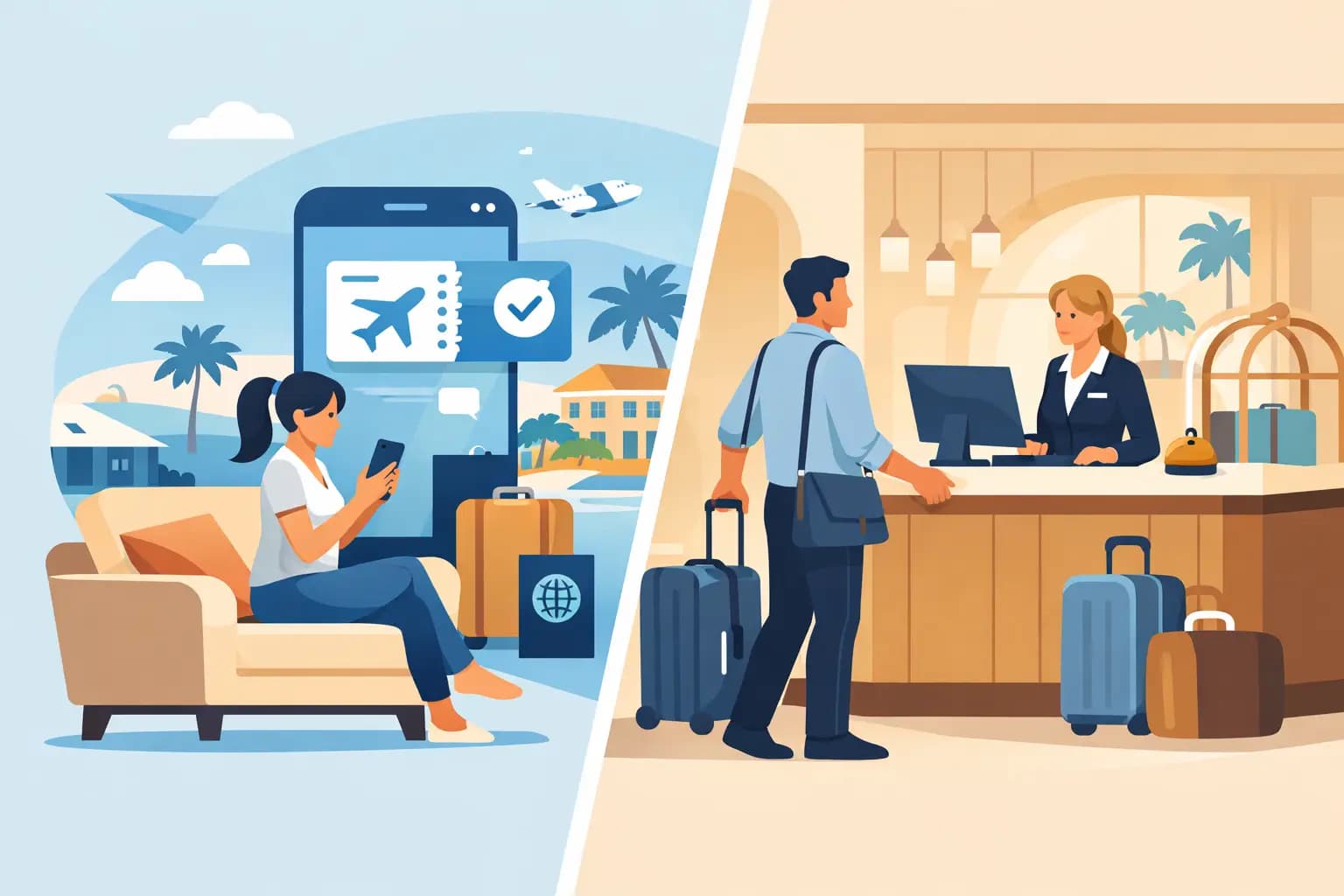
An arrival with a queue of five guests, an ID waiting to be registered and a room that still needs checking can shape the whole first impression. The decision between online vs in-person check-in is not about replacing hospitality with a screen. It is about deciding which tasks technology should handle and when your team adds the most value for the guest and the business.
For a hotel, holiday apartment, campsite or rural stay, the right model depends on arrival volume, guest profile, available staff and how complex the operation is. Online check-in reduces friction and administrative workload; in-person check-in lets you guide, sell and resolve exceptions. Done well, they are not opposing models but parts of a more profitable front desk.
Online vs in-person check-in: the operational difference
Online check-in lets guests complete part of the admission process before they arrive: personal details, signature, acceptance of terms, payment or guarantee and, where applicable, the information needed for guest registration. The property receives the data in advance and can review any issues before the guest walks through the door.
With in-person check-in, these tasks are concentrated at the front desk. Staff ask for documentation, register the guests, handle payments, explain the services and hand over the key or card. It is the traditional process, but it need not be slow if the booking information is already centralised and available.
The relevant difference is not only where the data is filled in. It is when the team does the work and how the critical points of the arrival are distributed. With a digital process beforehand, the front desk no longer spends so many minutes transcribing information. With an in-person process, the guest gets immediate attention from someone who knows the property and can step in if anything goes wrong.
What a property gains from online check-in
The main advantage of online check-in is anticipation. If guests complete their registration before travelling, the team knows in good time who is arriving, what information is missing, whether there is a special request and whether a payment needs following up. This visibility helps with planning shifts, housekeeping, room allocation and communication with the guest.
It also reduces the manual tasks that generate the most errors: copying data from documents, chasing signatures, checking incomplete fields or asking again for information already given during the booking. In high-occupancy periods, a few minutes saved per arrival add up to many hours freed up for handling requests, checking rooms and managing sales.
The commercial impact deserves attention too. A well-designed digital flow can present extras at the right moment, such as breakfast, late check-out, parking, pets, experiences or a room upgrade. The aim is not to show offers without context, but to make useful decisions easier before arrival, while the guest is still organising their stay.
For the traveller, the benefit is independence. Guests who arrive late, travel with children, have driven for hours or simply want to get to their room quickly value not having to repeat basic details at the desk. In properties with automated access or limited reception hours, this independence can be decisive for operating without increasing headcount.
But going digital does not mean sending out a generic form. The process must be short, mobile-friendly, clear about how data is used and connected to the actual booking. If it forces guests to create unnecessary accounts, includes confusing steps or fails when uploading documents, it has the opposite effect: more enquiries and a more stressful arrival.
When in-person check-in is still decisive
In-person check-in keeps an advantage that no automation should underestimate: the ability to read the situation. A receptionist can tell that a family is tired, that a guest does not understand the language, that the assigned room does not meet a mobility need or that a couple is celebrating a special occasion. That conversation lets you act before the problem turns up in a review.
It is also valuable in properties where the experience is part of the product. A boutique hotel, a rural stay with activities, a resort with multiple services or a campsite with specific rules can use the arrival to orient guests, explain the surroundings and recommend services. The welcome is more than a formality when it helps increase average spend and satisfaction.
Moreover, there are cases where being there in person simplifies things. Some guests prefer to hand over their documents, pay at the desk or get help with the booking. Others arrive with last-minute changes, undeclared companions or requests that need an immediate solution. Forcing the digital channel in these situations can shift the problem onto the guest and swamp the support team.
The point is not to keep the desk out of habit. It is to reserve human intervention for what requires judgement, empathy or the ability to make decisions. Asking for a name and a signature is a task that can be automated. Resolving an incident, turning around a bad experience or converting an enquiry into a sale is not the same.
The hybrid model often delivers better results
For many properties, the answer to online vs in-person check-in is not to choose one and eliminate the other. The most effective model combines digital registration beforehand with a front desk that is available and prepared. The guest provides their data before arriving; the team validates the information, prepares the stay and uses the welcome to help, inform and personalise.
This approach cuts queues without losing the personal touch. If everything is in order, the arrival can take seconds. If an exception comes up, staff have more time and context to deal with it. The result is a less reactive front desk, with less repetitive work and more capacity to look after the details that do shape the perception of quality.
In a city hotel with many arrivals concentrated between 3 pm and 8 pm, online check-in helps avoid operational peaks. In a holiday apartment with self check-in, it allows you to operate smoothly and keep guests informed. In a rural stay, it can free the host from paperwork so the arrival can be spent explaining routes, opening times and local services. Technology should adapt to the business model, not force the business to operate like everyone else.
How to choose the right process for your property
Before introducing or changing the system, it is worth observing the operation for several weeks. How long does each arrival take on average? What data is requested twice? At what times do queues form? How many enquiries come in because the guest did not receive clear instructions? Which extra sales are lost for lack of time at the front desk?
With those answers, the decision stops being based on personal preference. If the biggest problem is mass arrivals, prioritise pre-registration and automated communication. If incidents are concentrated among guests with particular profiles, it may be better to offer online check-in as an option and keep a visible, simple in-person alternative.
Technology integration is another critical point. The admission process must be connected to the PMS, bookings, payments and availability information. Working with isolated forms means reviewing, exporting or copying data, precisely what you wanted to avoid. A platform like Avirato lets you centralise this operation so that guest data travels with the booking and the team works from a single environment.
You also need to define who is responsible. Automating messages does not remove the need for supervision. Someone has to monitor incomplete registrations, pending payments, late arrivals and special requests. The difference is that this person can do it proactively, without waiting for the guest to be standing at the desk.
Make sure automation does not erode trust
A good online check-in communicates precisely. Guests must know what they need to complete, why their data is requested, when they will receive arrival instructions and who to turn to if they need help. Short messages sent at the right moment work better than a chain of emails with scattered information.
Security and regulatory compliance are not minor details either. Personal data, documentation and payments require controlled processes, appropriate permissions and traceability. Choosing a tool because it is fast, without checking how it handles information, can create more operational risk than it saves.
Finally, measure the results. Review the rate of registrations completed before arrival, the average service time at the front desk, the number of incidents, ancillary sales and the reviews relating to the arrival process. If the system does not improve these indicators, you need to adjust messages, steps or automation rules.
The best arrival is the one the guest barely perceives as a formality and the team controls without stress. Design the process so that technology takes care of the repetitive work and your staff have time to do what really sets a property apart: welcoming well, solving problems quickly and building trust from the very first minute.