
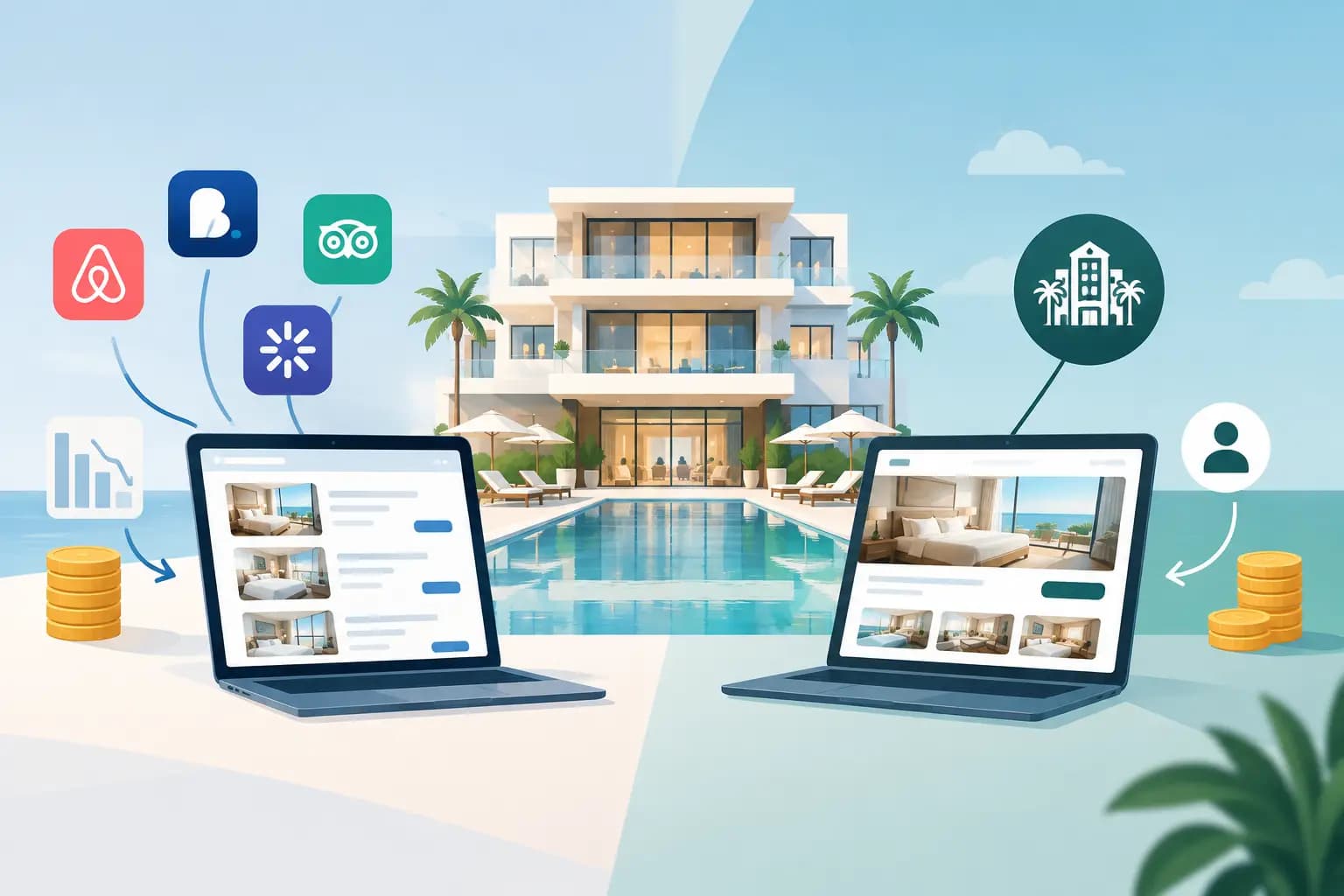
A booking that comes in through an OTA can fill a room today. A booking that comes in through your own website can fill that same room, keep more of the margin and open the door to a direct relationship with the guest. The OTA vs own website debate is not about choosing one channel and shutting the other: it is about deciding what role each one should play in growing your property’s revenue.
For an independent hotel, a holiday apartment business or a campsite, OTAs provide visibility in markets where your brand is not yet known. Your own website, on the other hand, is the place where you control the price, the message, the guest data and the booking experience. Profitability appears when both channels work in step, rather than competing with each other without a strategy.
OTA vs your own website: it is not an either/or choice
OTAs are high-reach shop windows. Booking, Expedia and other distributors spend huge budgets on advertising, search ranking and technology to capture demand. Being connected to these channels lets you sell in low-occupancy periods, reach international markets and generate bookings without bearing the full cost of acquiring them directly.
The price you pay is the commission. Depending on the channel, the destination and the commercial agreement, that commission can noticeably reduce the net revenue per room. On top of that, the property has less room to build loyalty: guests compare plenty of options, book inside the platform and may not search for your hotel’s name on their next stay.
Your own website plays a different role. It should not be seen simply as a business card, but as an active sales channel. With a fast booking engine, clear rates, secure payments and a visible value proposition, your website turns interest into bookings with no intermediary commission. It also lets you use commercial tactics that are limited on an OTA: packages, promo codes, upselling of extras, targeted campaigns and perks for returning guests.
The right question is not whether it is better to sell through OTAs or through your own website. It is which booking the hotel needs to win at any given moment and what its real net cost is.
What each channel brings to a hotel business
An OTA can be decisive when a new property opens, when you head into a low-demand season or when you need to strengthen your presence in specific markets. It also helps build reputation through reviews and reach travellers who do not yet know your property. Giving up these channels altogether usually limits your commercial reach, especially in competitive destinations.
Your own website offers advantages that go beyond saving on commission. The hotel gets to know the person booking, can communicate before arrival and can personalise the stay. It can offer breakfast, late check-out, parking, local experiences or flexible terms during the booking process. Each of these options raises the average booking value and improves the guest experience.
There is another key difference: dependence. If too large a share of your sales comes from a single intermediary, any change in its algorithm, commission, visibility or commercial policy can hit your occupancy directly. A healthy distribution strategy does not remove OTAs, but it stops them from having total control over your property’s demand.
Compare net revenue, not just bookings
A room sold at 120 euros does not always produce the same result. If it comes through an OTA with an 18% commission, the revenue before other costs falls to 98.40 euros. If it is sold on your own website, there will be technology, marketing and payment gateway costs, but the margin can be higher and the hotel keeps the commercial relationship.
This does not mean every direct booking is automatically more profitable. A poorly targeted advertising campaign can send acquisition costs soaring. That is why it pays to measure the acquisition cost per channel instead of stopping at the commission percentage. The decision should rest on data: net revenue, cancellations, average length of stay, booking lead time, additional spend and repeat guests.
It is also worth analysing behaviour by date. On a bank-holiday weekend with strong organic demand, the hotel can prioritise direct sales and limit availability on the costliest channels. In a week of low occupancy, OTAs can give the boost needed to get sales moving. Managing inventory and rates with this logic lets you protect your margin without losing exposure.
Four indicators for better decisions
- Share of bookings and revenue by channel.
- Average commission and the real acquisition cost of each booking.
- Average booking value, including extras and services.
- Percentage of repeat guests and their subsequent direct bookings.
These figures turn a discussion based on impressions into a commercial decision. If the OTA brings volume but direct bookings have higher value and repeat business, the aim is not to cut the OTA. It is to use it to capture demand and to build ways for the next contact with that guest to be direct.
How to boost your own website without losing distribution
Direct sales do not grow just by asking guests to book on your website. There has to be a clear reason for them to do so. The best available rate can be one argument, as long as it respects the applicable commercial terms, but it should not be the only one. Guests respond better when they see value: more flexible modification terms, a welcome treat, parking included, a special breakfast or access to an exclusive offer.
The booking experience matters too. A slow website that is unclear or hard to use on mobile pushes users back to the OTA, where they already trust the process. Your booking engine should show real-time availability, explain the room types well and let guests complete payment without friction. If a user has to phone to confirm a rate or finds differences in availability, the direct channel loses credibility.
Rate consistency is just as important. Your PMS, channel manager and booking engine must sync inventory, restrictions and rates quickly. That cuts errors, prevents overbooking and spares your team from updating every channel by hand. Centralised operations let you adjust your strategy in minutes, not after checking several platforms.
Avirato helps you connect distribution and direct sales within a single ecosystem: PMS, channel manager, booking engine, payments and commercial tools work from a shared view of inventory and revenue. For the hotel, this means fewer repetitive tasks and more capacity to act on demand.
An OTA guest can also become a direct customer
Loyalty starts during the stay, not only after a campaign goes out. Even if the original booking comes through an OTA, the hotel can provide excellent service, offer a smooth online check-in and share relevant services before arrival. The goal is for guests to remember the experience at your property, not just the platform where they booked.
After departure, respectful communication that complies with the guest’s consent can encourage them to book directly on their next visit. The benefits need to be concrete and easy to understand. A generic code with no context usually has little impact; an offer tailored to their type of stay has a better chance of working.
The idea is not to pressure the guest or to promise discounts that damage profitability. It is to show that booking directly brings convenience, attention and added value. If the guest notices that difference, your own website stops being a secondary channel.
A strategy that changes with occupancy
There is no ideal split between OTAs and direct sales that works for every property. An urban hotel with strong corporate demand faces a different reality from a rural property that concentrates its bookings at weekends and during holidays. Brand, destination, season, booking lead time and market mix all shape the strategy.
What does work in any model is reviewing results continuously. When occupancy rises, the hotel can hold back inventory for its direct channel and improve its margin. When it falls, it can raise its visibility on OTAs, launch campaigns or create specific packages. Revenue management is not about filling rooms at any price, but about selling each room through the most suitable channel and at the most suitable value.
The OTA brings reach. Your own website brings control, margin and a relationship with the guest. When technology keeps rates, availability and payments connected, your team can stop fighting operational fires and spend more time on commercial decisions that grow the business.