
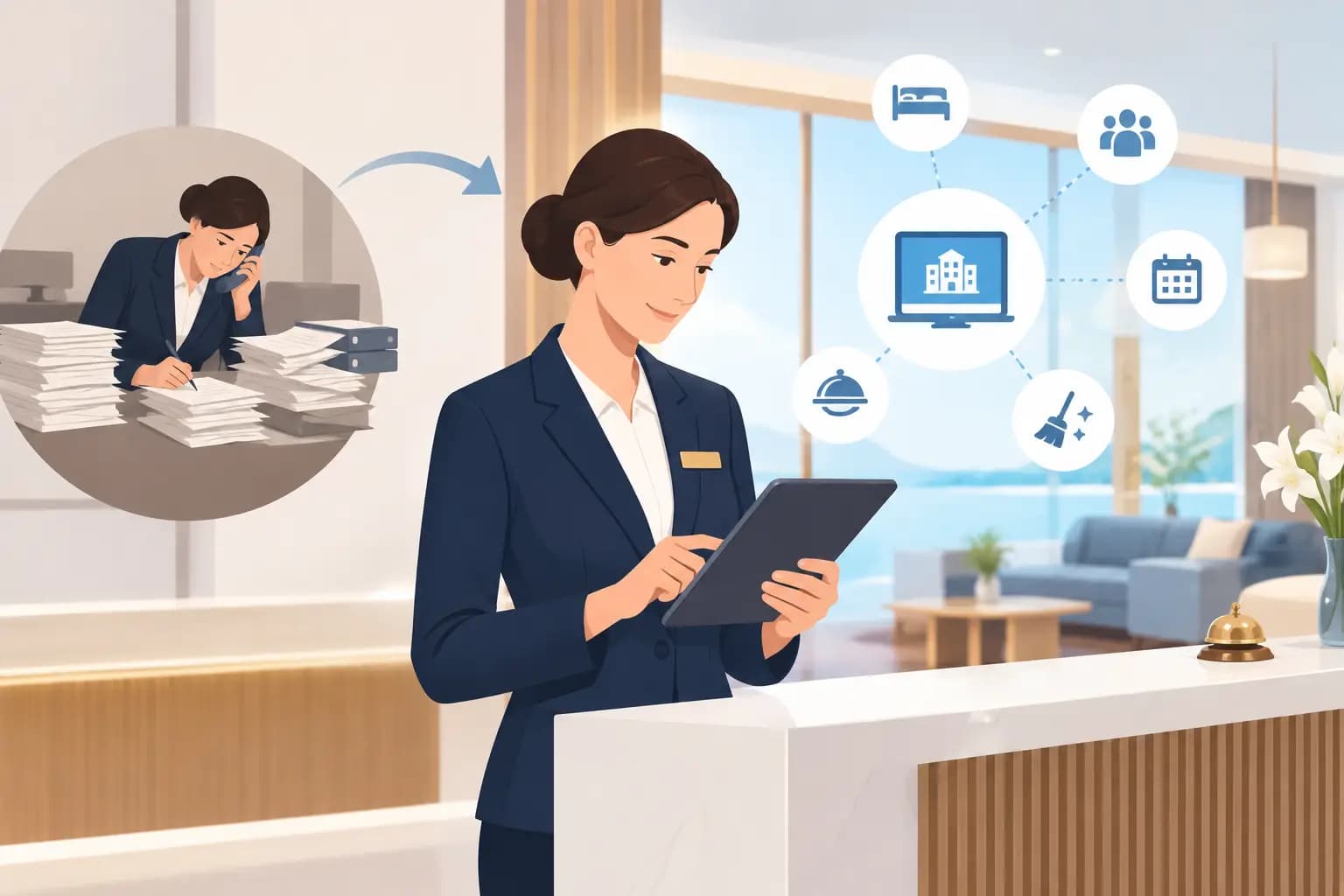
A change of date that forces you to update the PMS, check availability on several OTAs, recalculate a payment and notify reception is not an isolated incident. It is a sign that your operations are fragmented. To reduce manual tasks in a hotel, it is not enough to digitise forms or add a new tool: you need to connect the processes that affect bookings, revenue and the guest experience.
Well-planned automation does not remove the team’s judgement. It removes the repetition, the hand-overs of information and the checks that consume hours without adding commercial value. The result is a hotel with more control over its inventory, fewer errors and more time to look after guests and make profitable decisions.
The real cost of working one process at a time
Manual tasks rarely show up as a single block of work. They build up in small gestures: copying a booking received by email, closing sales on an OTA, checking whether a payment has arrived, sending the same arrival message or updating a rate on several channels. Each action seems manageable. Together, they slow the operation down.
The problem is not just administrative time. When information travels between spreadsheets, emails, disconnected systems and internal messages, the risks of outdated availability, pending payments, invoicing errors and overbooking increase. What’s more, the front desk team ends up working reactively, dealing with incidents that an automated flow could have prevented.
For management and revenue management, this fragmentation also limits the ability to grow. If updating prices means stepping in channel by channel, reacting to a demand peak comes too late. If direct bookings do not flow automatically into the central system, measuring their profitability and acting on them becomes slower.
Which tasks to automate first
Not all processes have the same priority. The best approach is not to automate because it is fashionable, but to start where high volume, repetition and risk of error coincide. In most properties, bookings, distribution, payments and pre-stay communication are the first candidates.
Centralise bookings and availability
Reception should not have to enter bookings by hand from OTAs, the booking engine, the phone or travel agencies. A PMS connected to a channel manager lets you gather the information in a single calendar and synchronise availability, restrictions and rates in real time.
This change reduces duplication and prevents a room from being sold twice because of a missed update. It also gives you an immediate view of real occupancy, the channels that are generating business and expected arrivals. For an independent hotel, it can mean freeing up several hours a day. For a chain or group, it makes it possible to keep common operating standards without losing visibility at property level.
Synchronisation must be fast and stable. There is little point in automating if inventory takes a while to update or if the team keeps checking external platforms to confirm that everything is correct. The technology should become the source of operational information, not an additional layer of doubt.
Update rates without repeating the work
Changing a rate manually on each channel does not just eat up time: it opens the door to inconsistencies in price and availability. An integrated system lets you define rules, seasons, supplements, minimum stays or stop-sells from a single point.
Price automation has its nuances. An urban hotel with highly variable demand may need more dynamic revenue rules than a rural property with marked seasonality. In both cases, the platform should make quick adjustments easy and keep human oversight in place. Automating does not mean leaving rates uncontrolled, but applying your strategy with greater speed and consistency.
When smart pricing is based on occupancy data, booking pace and demand behaviour, the team can stop spending time on mechanical tasks and focus on more profitable questions: which dates need a boost, which channel to prioritise or when to protect inventory for direct sales.
Digitalise payments, guarantees and invoicing
Chasing payments, recording cards by hand or checking bank transfers one by one creates an administrative burden that directly affects reception and accounts. Payment integration lets you automate payment requests, guarantees, deposits and transaction reconciliation according to your property’s policy.
As well as saving time, this process improves traceability. The team knows which booking has been paid, which one needs following up and what amount is outstanding before arrival. In periods of high occupancy, that clarity reduces last-minute disputes and speeds up check-in.
Clear rules are also needed here. Not every booking requires the same deposit or the same cancellation policy. The aim is for the system to apply the right conditions by rate, channel or season, without forcing staff to remember exceptions in every transaction.
Prepare check-in before the guest arrives
Arrival concentrates many tasks: collecting data, signatures, payment, room allocation, information about services and handling requests. If everything happens at the desk, queues form and the first contact with the guest loses quality.
Online check-in lets you request details and documents before arrival, send personalised communications and have much of the operation ready in advance. Reception can then focus on welcoming guests, meeting specific needs and recommending services, instead of transcribing information.
Not every guest will complete the digital process. That is why automation must coexist with quick, attentive face-to-face service. The key is to offer guests a convenient alternative and to give the team an up-to-date record before the hotel door opens.
Reduce manual tasks in a hotel without losing control
The most common objection is a reasonable one: if processes are automated, how do you avoid losing control? The answer lies in designing flows with rules, alerts and owners. The system can carry out repetitive actions, but management must keep visibility over exceptions, significant changes and commercial results.
For example, an alert can flag a booking without a guarantee, a stay with a pending payment or an abnormal drop in demand. That way, the team does not review everything as a matter of routine, but steps in when a situation calls for judgement. It is a change of model: less manual monitoring, more management by exception.
It is also essential to define which data takes precedence. If the PMS is the operational core, reception, reservations, payments and distribution must all draw on that same information. Maintaining several parallel databases is usually a temporary solution that ends up multiplying errors.
How to roll out automation with real impact
Before changing technology, it is worth measuring where the time goes. For one week, record how many actions are repeated and what incidents they cause: booking changes, rate updates, confirmations, payments, invoices or communications. This initial snapshot helps you set priorities and avoids investing in features that do not solve the main bottleneck.
Then set an order of implementation. First, connect the core of reservations and distribution. Next, add payments and automated communications. Finally, activate more advanced rules for revenue, loyalty and marketing. Trying to transform every process in a single day can create internal resistance and make training harder.
Training is part of the project’s profitability. A team that understands why a rate rule was created, or what happens when a booking comes in from an OTA, will trust the system more and spot a genuine exception sooner. Automation does not replace hospitality know-how: it gives it scale.
A comprehensive platform such as Avirato lets you bring PMS, channel manager, booking engine, payments and commercial tools together within a single ecosystem. For the property, this reduces dependence on disconnected suppliers and makes it easier for data to follow the guest from booking to departure.
The time you recover must turn into revenue
Saving hours is a good start, but it is not the end goal. The hours once spent copying data or checking channels should be used to improve direct sales, review your pricing strategy, respond faster to commercial opportunities and look after the guests who have already chosen your property.
A more automated hotel is not a less human hotel. It is a hotel where the team stops chasing tasks and goes back to managing the business. Start with one process that currently causes errors or delays and turn it into an operation that is measurable, connected and easy to supervise. That is where efficiency starts to show up in turnover.