
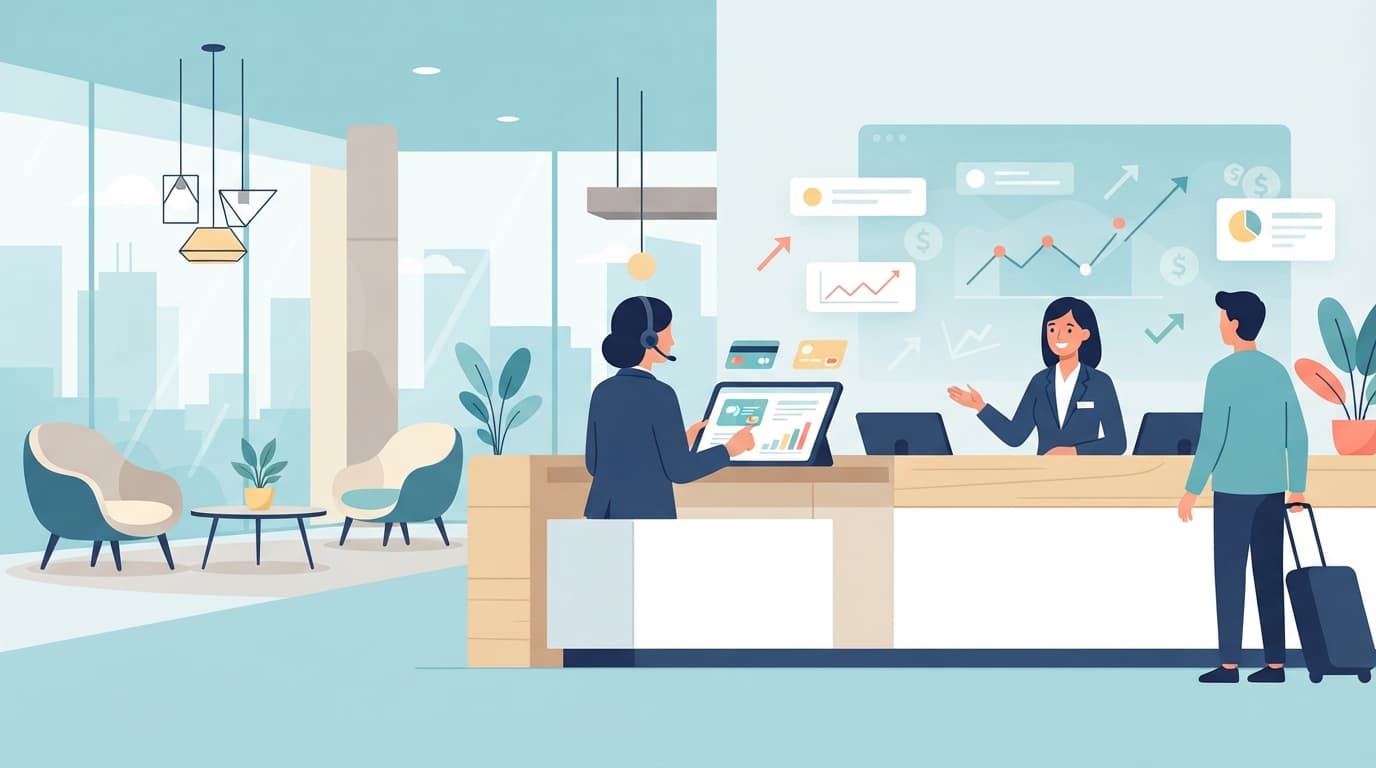
Hotel revenue management with integrated payments brings together two critical levers: optimising rates and availability while automating payment collection to capture every pound of value. A hotel that integrates its payment gateway into the PMS reduces cancellations, accelerates cash flow and obtains clean data to make informed pricing decisions.
What is hotel revenue management with integrated payments?
It is the strategy that aligns pricing and sales decisions with payment execution on a single platform. Traditionally, hoteliers set rates in one tool and managed payments separately, often with manual processes that led to errors, delays and revenue leakage. Integrating both worlds into a PMS like Avirato changes the game: every booking, whatever the channel, is linked to an automated payment that respects the cancellation, guarantee and policy rules you have defined.
It is not just about collecting faster. It is about payment data feeding back into your revenue strategy. If a segment pays further in advance, you can adjust the cancellation policy for that channel. If an OTA generates more failed payments, you can tighten the guarantees for that source. Payment integration gives you visibility into the real behaviour of money, not just bookings on paper.
Why payment collection directly impacts your revenue
Classic revenue management focuses on occupancy and ADR, but actual revenue depends on how much, when and how you collect. Poorly managed payments can turn a profitable booking into a loss: poorly negotiated gateway fees, fraud-related refunds, late cancellations without effective penalties, or simply hours of manual work chasing transfers.
With integrated payments in Avirato, collection stops being a bottleneck. The system executes automatic charges according to the rules you configure: prepayment, payment on arrival, deposit, late cancellation penalty. Everything is recorded and reconciled, freeing up the front desk team and avoiding disputes with guests. This allows the revenue manager to focus on deciding the best rate, knowing that collection will run smoothly.
Key data: how the approaches compare
| Approach | Who it's for | When to use it |
|---|---|---|
| Integrated payments with PMS | Hotels and chains looking to automate collections and reduce friction | Always, as the operational foundation |
| Manual payments + separate revenue | Small properties with low volume | Only if management time is not a significant cost |
| External gateway without integration | Businesses prioritising commission costs over automation | When the team takes on manual reconciliation |
| Revenue with automatic payment rules | Hotels with a strict cancellation policy | To protect revenue in high season |
How to apply revenue management with integrated payments in your hotel
First, define your business rules: what percentage do you charge in advance? When do you charge the card? How do you penalise cancellations? Then configure those rules in your PMS. Avirato lets you automate these workflows and connect them to your booking engine and channel manager, so that every direct or OTA booking follows exactly the same process.
Second, analyse payment data. How many bookings are cancelled at the last minute? Which channels generate the most failed payments? Cross-reference that information with your pricing decisions. If a channel has a high risk of no-shows, increase the rate or require full prepayment. If your direct website has few cancellations, you can offer a slightly lower rate than the OTAs and still earn more margin, because you don't pay commission and you collect earlier.
Third, automate communication. Guests should know when and how they will be charged. With integrated payments, the system can send payment reminders, charge confirmations and automatic receipts. This reduces front desk queries and improves the perception of professionalism. It also frees up time for your team to better serve guests in person.
Tangible benefits for hoteliers
- Reduced manual work: forget about collecting payments by hand and reconciling statements.
- Fewer errors: the system always applies the same rule, without relying on anyone's memory.
- Better cash flow: you collect earlier and predictably.
- Data to decide: you know which segments and channels pay best, and you adjust your revenue strategy accordingly.
In my experience advising hotels, resistance to integrating payments often comes from a fear of complicating the process or losing control. But the reality is the opposite: by automating, you gain control. You know exactly what has been charged, when and from whom. And guests appreciate a clear process with no surprises.
To delve deeper into how online check-in complements digital payments, I recommend reading Online check-in and digital payments: keys to a better guest experience. You may also be interested in AI for the guest experience: online check-in and digital payments.
Common mistakes when combining revenue and payments
One of the most frequent mistakes is failing to align the cancellation policy with payment automation. If your PMS does not automatically charge the penalty, that policy is useless. Another mistake is using a payment gateway that does not integrate with your channel manager, which forces you to treat each channel differently and multiplies the work.
It is also a mistake to ignore payment data when setting prices. If you notice that a specific segment pays late or generates disputes, simply raising the rate is not enough: you need to change the payment conditions for that segment. Integration allows you to do this in a granular way.
Finally, do not communicate charges poorly to guests. Transparency in payment reduces complaints and improves online reputation, which in turn supports your long-term revenue strategy.
How to get started with integrated payments in Avirato
The first step is to review your current technology stack. If you already use a PMS, check whether it offers native integrated payments or whether you need an external gateway. In Avirato, payments are integrated as standard, along with the booking engine, channel manager and revenue management. That means you can configure everything from a single panel and see the complete data for each booking: price, channel, payment status and rules applied.
Next, define your payment rules and test them with a small group of bookings. Adjust the automatic messages and train your team on the new workflow. You will see that within a few weeks the time spent on collections drops dramatically and the information available for pricing decisions improves.
If you want to see how it works in your specific case, request a free Avirato demo and we will show you how to unify revenue management and integrated payments to maximise your revenue without adding manual work.
Frequently asked questions
What is the difference between revenue management and integrated payments?
Revenue management focuses on deciding prices, availability and sales policies to maximise revenue. Integrated payments automate the collection of those bookings according to the defined rules. Together, they ensure that every pricing decision translates into a real, frictionless payment.
How does a PMS with integrated payments help reduce cancellations?
By automating the collection of deposits, prepayments or late cancellation penalties, hoteliers discourage last-minute cancellations. In addition, the system records every transaction and makes it easier to apply strict policies without relying on manual management by the team.
Can I use integrated payments with OTA bookings and my direct website?
Yes. A PMS like Avirato centralises payments from all channels on a single platform. You can define different payment rules for each channel or segment, and the system executes them automatically, keeping reconciliation up to date.
What type of accommodation benefits most from integrating payments and revenue management?
Independent hotels, chains, tourist apartments, hostels, campsites and rural houses. Any business that wants to reduce manual tasks, collect predictably and make pricing decisions based on real payment data benefits from this integration.
Is it complicated to migrate to a system with integrated payments?
Not if you choose an all-in-one platform. In Avirato, configuration is guided and the support team helps with the migration. Within a few days you can have the booking engine, channel manager and integrated payments up and running, with automatic rules working.