
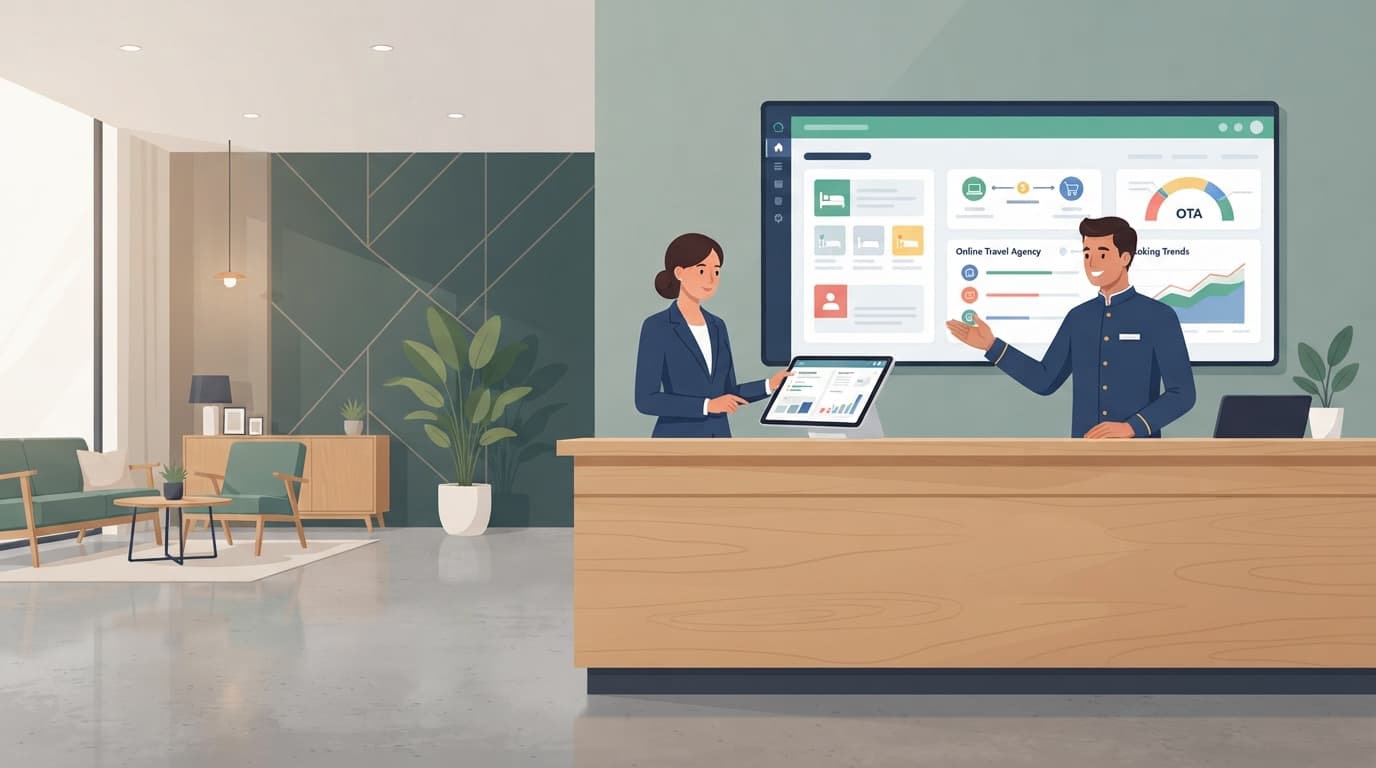
A channel manager for hotels is the tool that syncs rates, availability and bookings across all sales channels in real time, preventing overbookings and discrepancies. Without this automation, manual distribution leads to costly mistakes and inefficient day-to-day operations that eat into your time and bookings.
OTA distribution and connectivity are at the heart of hotel online sales. You connect your PMS to Booking, Expedia, your booking engine and other channels. If information doesn't flow properly, errors creep in: duplicate bookings, incorrectly loaded rates, rooms oversold. And that means furious guests and lost revenue.
I've seen hotels updating availability by hand on each extranet. It's exhausting and risky. One busy afternoon, one slip-up, and you've sold the same room twice. The cost isn't just the commission: it's your reputation. That's why choosing a good channel manager isn't a minor technical decision. It's a business decision.
What is a channel manager and why do you need one?
A channel manager is software that centralises online distribution. It connects your PMS to online travel agencies (OTAs) and other sales channels. It updates rates and availability automatically and in both directions. So when someone books on Booking, the room is blocked across all channels instantly.
The alternative is manual management. Logging into each extranet, changing prices, closing rooms. It's slow, error-prone and doesn't scale. If your hotel has more than 10 rooms and works with 3 or more channels, automation is essential. It's not a luxury: it's an operational necessity.
Common mistakes in hotel distribution (and how a channel manager prevents them)
These are the failures I see most often in daily operations, and which a properly configured channel manager eliminates:
| Mistake | Consequence | How the channel manager prevents it |
|---|---|---|
| Overbooking | Guests with no room, bad reviews, relocation costs | Instant inventory sync across all channels |
| Outdated rates | Lost revenue or inconsistent prices | Automatic rate updates from the PMS |
| Manual entry errors | Incorrectly recorded bookings, wrong data | Automatic transfer of bookings to the PMS |
| Delays in closing sales | Rooms sold when there's no availability left | Real-time sales closure across all channels |
How to choose a channel manager for hotels: evaluation checklist
Not all channel managers are created equal. Before deciding, evaluate these points:
- Channel coverage: Does it connect to the OTAs your hotel uses and to your direct booking engine? Can you add new channels?
- Immediate sync: Does it update availability and rates in real time or with delays? Every minute counts.
- PMS integration: Does it work natively with your PMS or does it require additional connections? Native integration reduces errors.
- Rate management: Does it allow channel-specific pricing rules, minimum-stay restrictions or sales closures?
- Reliability and support: What happens if there's a connection problem? Do you have accessible human support?
- Ease of use: Can your team handle it without complications? The learning curve matters.
A good channel manager doesn't just prevent mistakes: it frees up time. Instead of updating extranets, your team can look after guests, plan rates or improve the experience. That time has a direct value in revenue and reputation.
How Avirato simplifies distribution and OTA connectivity
Avirato integrates channel manager and PMS into a single platform. That means no friction between systems: distribution is managed from the same place where you manage bookings, guests and payments. Sync is immediate, which reduces the risk of overbooking and keeps rates consistent across all channels.
What's more, because everything is unified, you get a complete view of the business. You can see which channels sell the most, adjust prices with judgement and automate repetitive tasks. It's not just about connecting to OTAs: it's about being in control of your distribution without relying on manual processes.
If you're evaluating how to improve your hotel distribution, I recommend starting with a simple diagnosis: how much time do you spend updating channels? How many availability errors have you had this month? If the answer is too much time or too many errors, it's time to automate.
Automating daily operations: fewer mistakes, more revenue
Automation isn't just about efficiency. It's a revenue strategy. Every overbooking mistake costs money and reputation. Every hour your team spends updating extranets is an hour not spent selling better or looking after guests.
A well-integrated channel manager reduces those hidden costs. And when combined with a PMS that centralises the entire operation, the effect is multiplied. Fewer manual processes, fewer mistakes, more control. That shows in the bottom line.
In my experience, hotels that automate their distribution don't just avoid problems: they gain agility. They can react to demand, adjust prices instantly and launch offers without fear of getting it wrong. That ability to react is what sets a competitive hotel apart from one that merely survives.
If you want to dig deeper into how a PMS can replace Excel and prevent mistakes, I recommend reading PMS or Excel for hotels: which is right for you?. You might also be interested in how to speed up reception with online check-in without the wait. And if you're looking to build guest loyalty to increase direct bookings, take a look at guest loyalty and revenue management.
Hotel distribution shouldn't be a headache. With the right tools, it becomes a competitive advantage. Start by choosing a channel manager that genuinely automates and reduces errors. Then build on that foundation.
If you want to see how Avirato can centralise your distribution and simplify your operations, request a free demo and discover how to save time and avoid errors when managing your channels.
Frequently asked questions
What is a channel manager and how does it work?
A channel manager is software that connects your PMS to online travel agencies (OTAs) and other sales channels. It automatically syncs rates, availability and bookings in real time, preventing overbookings and discrepancies.
What's the difference between a channel manager and a PMS?
The PMS manages the hotel's internal operations: bookings, guests, invoicing, check-in. The channel manager handles distributing inventory and rates across online channels. Ideally, both should be integrated for smooth, error-free management.
How can a channel manager prevent overbooking?
The channel manager updates availability across all channels in real time. When a booking is made on any channel, the room is automatically blocked on the others, preventing you from selling more rooms than are available.
Can I manage my rates differently depending on the channel?
Yes. An advanced channel manager lets you apply channel-specific pricing rules, minimum-stay restrictions, sales closures and targeted promotions. This gives you full control over your distribution strategy.
How long does it take to implement a channel manager?
It depends on the provider and the integration. With unified platforms that combine PMS and channel manager, implementation tends to be quicker and simpler, as there's no need to connect third-party systems.